

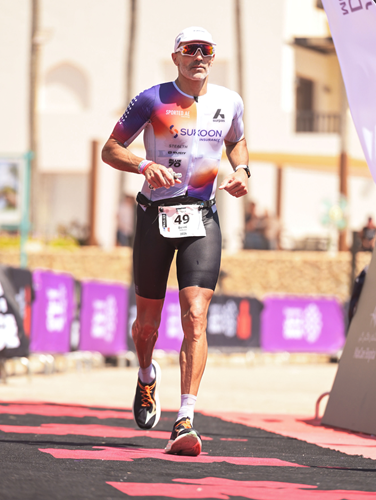
Mehdi Benni reporting on IRONMAN 70.3 Dhofar
Race Report
My second race in Oman this year. Back in February, I’d had a great experience at IM 70.3 Muscat, but a hip injury had compromised my run (due to poor run prep) and left me with a sense of unfinished business. I knew I wanted another shot. I just didn’t want to rush it.
The build-up
While browsing the calendar, I spotted Salalah in October. With much of the event taking place around a resort and marina, it looked like the perfect opportunity to combine a race with a few days away with the family. Decision made, registration done!
As October approached, I signed up for two local Olympic-distance races to sharpen my fitness and build confidence, especially on the run. My hip was still sensitive, so I hadn’t been able to get the long runs I wanted into my preparation.
The second race, just one week before the 70.3, turned out to be one I probably should have skipped. I injured my heel on the 500-metre run from the water to T1 and, as a little bonus, got disqualified for missing a lap on the bike.
I remember one day before that race coach David Hunt saying “don’t crash or hurt yourself one week before Salalah” 🙃
Lesson learned: next time, I’ll weigh that potential 5% benefit to my preparation against the much bigger risk of racing a week before the main event.
Race week: family time, bike prep and buckets of ice
Tuesday arrived, and we headed to the airport. My physio and coach’s instructions were simple: ice the heel as much as possible and avoid walking. Not the easiest advice to follow when navigating airport terminals. By the end of the journey, I was seriously questioning whether I’d be able to run four days later.
A few hours later, we landed in Salalah. It was still early in the week, chill atmosphere, 15min out of the plane we were already awaiting at the baggage belt with only a handful of triathletes waiting for their bike boxes. The arrival was refreshingly stress-free, friendly taxi drivers, clearly displayed fares, and 45 minutes later, we were at the hotel.
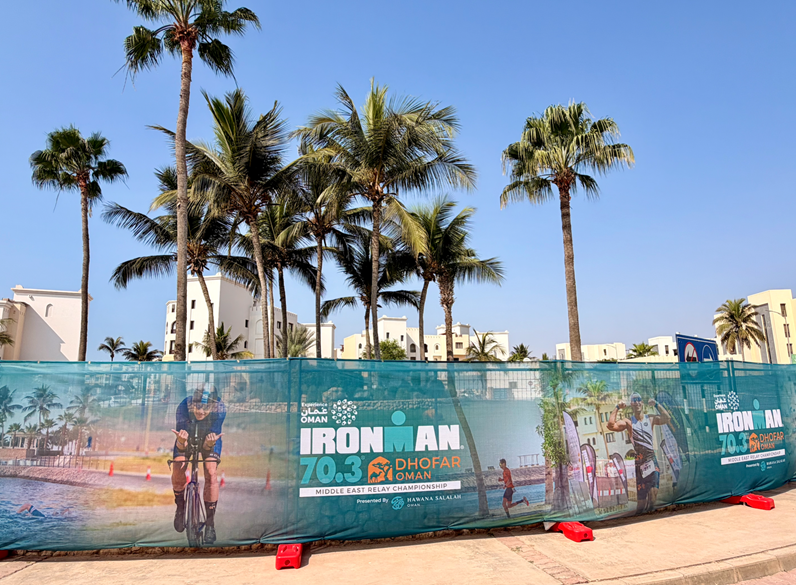
Pool time for the kids, bike unpacking and heel icing for Dad. The week’s programme was set.
I then realised I’d forgotten my heart-rate strap. Not a disaster, I know my “mod/med/mad” paces, but I do like having reliable heart-rate data when racing middle distances in the heat.
The next morning, I headed out for my first bike session. At 9:00 a.m., it was already 36°C+, it confirmed this was going to be a hot race.
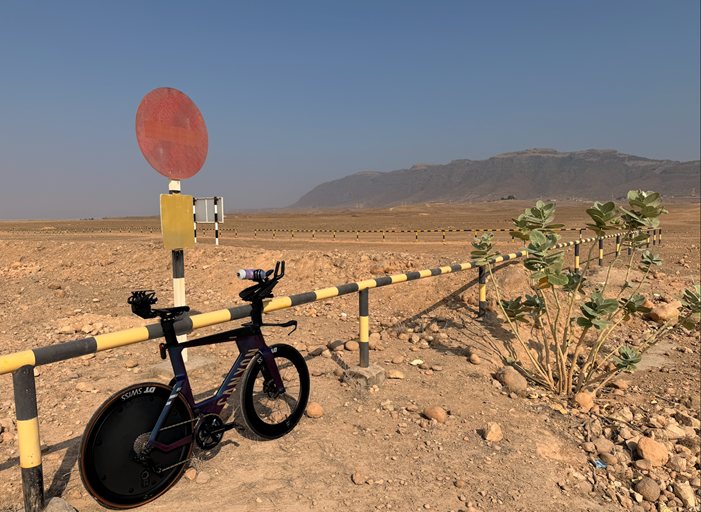
The rest of the week was a mix of easy rides, swims and rest, until my teammates Marc and Joe arrived on Thursday. I got lucky, Joe brought two HR belts and kindly lent me one “Thanks Mate!”.
Bibs collected, our juniors delivered at the IRONKIDS race, and we enthusiastically embraced our roles as supporters before switching our attention to race day.
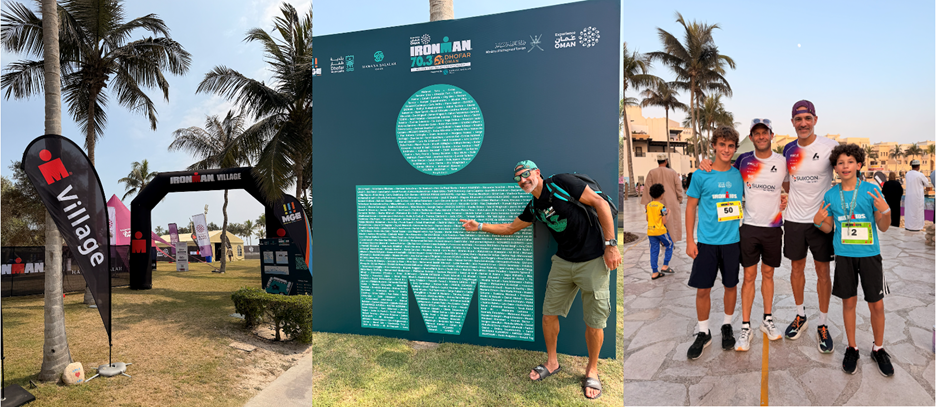
By Friday night’s final room-service order, the waiter felt like an old friend. He’d been bringing buckets of ice to the room four or five times a day since I checked in. The good news? The routine seemed to be helping, and the heel pain had eased.
Race morning
Saturday, 4:00 a.m. The alarm went off.
The hotel had opened breakfast early for the athletes, so at 4:30 a.m. the three of us sat down to fuel up on carbs.
Two hours later, we were on the start line.
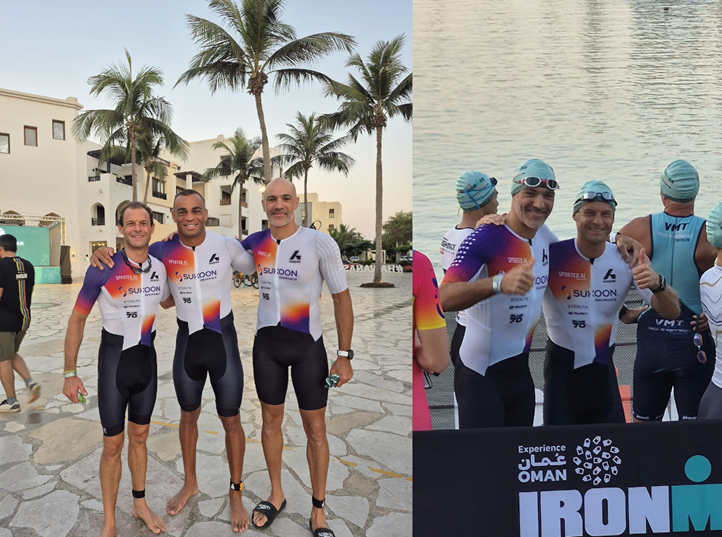
I was excited but relaxed, enjoying the atmosphere. My target was to beat my previous 70.3 time of 4:58, when I’d struggled on the run. With so little running in the build-up, perhaps I was setting myself up for a repeat. But there was only one way to find out.
The swim: an unexpected lesson in adaptation
Marc and I entered the water side by side, same kit, same entousiasm, here we go!
I hadn’t even reached the first buoy when, barely 50 metres in, I felt my goggles suddenly come loose. At first, I thought they’d slipped off my cap. Then I realized the strap had snapped!!?
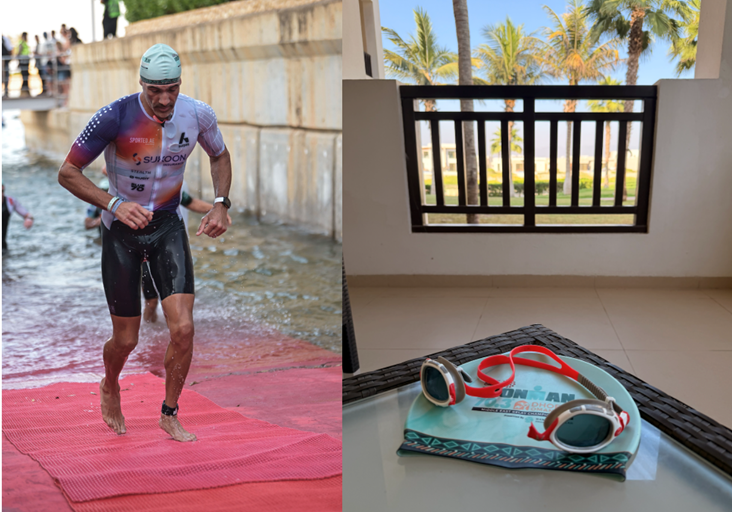
A quick message to the sporting gods: “I swim four times a week, every week. Why choose race day and the first 50 meters to break my goggles?!”🙏
Still, I stayed calm, tucked them down the front of my trisuit and decided straight to carry on without them.
Keeping my eyes open in the salt water wasn’t much fun, so I focused on long strokes with my eyes closed, briefly opening them to stay roughly in the right direction. Then I spotted a swimmer on my left who was moving at roughly my pace, I decided to stay alongside and thought “you will be my eyes”. Not ideal, but surprisingly manageable.
Then, around 500 meters in, we turned left at a buoy and straight into the sun. Now I could barely see anything, including the swimmers around me. I started bumping into people, honestly, it was a bit of a blind mess. My build (86kg) definitely helped me to make my way, “sorry guys!” ☺️.
I stopped a couple of seconds, blinked 10 times to locate the next buoy and realised it was directly towards the sun. Fine. Stop overthinking it. Follow the sun 🙌
Reaching that buoy was a huge relief. After the next left turn, I regained about 20% of my vision, found a new “pilot fish” and followed him to the swim exit.
Only after the race did I discover that I’d finished first in my age group on the swim, averaging 1:39/100 m. An open-water PB without wetsuit neither googles. How come!?
A good lesson in adaptability: losing your bearings doesn’t have to mean losing confidence in your ability to find a way through.
The bike: from finding my rhythm to managing cramps
A smooth T1, and I was happily aboard my new TT bike, ready to enjoy the scenic corniche route: 45 km out towards the city of Mirbat, then 45 km back to T2.
Rolling and fast, the kind of course I usually enjoy. But Coach David Hunt had warned me to stay conservative on the way out. This was a route that could punish anyone who got carried away early.
The first warning came after about 15 minutes. My legs weren’t feeling terrible, but whenever I pushed harder, they took longer than usual to recover. Something wasn’t quite right.
I didn’t panic. I settled into a controlled effort, passed a few riders and paid close attention to hydration and nutrition. Conservative, sure. But it still has to be fun 🤘! I really enjoyed holding the aero position at 50+ km/h on some sections.
As I approached the turnaround, I started counting the riders already heading back on the opposite side of the road. I wasn’t too far from the front (roughly top 15 overall) and felt I might be in a good position among the age-group contenders.
I grabbed a water bottle at every aid station to cool down and to practise catching them at 30 km/h. 100% success rate! Pretty happy with that. I know it’s nothing special, but it’s always nice to feel like a pro 🤙
I finally made the U-Turn, and 5kms later, first cramps arrived! They came on suddenly, at the worst moment, right before a long climb, and it completely changed my race. I could barely get out of the saddle, and every hill became a struggle.
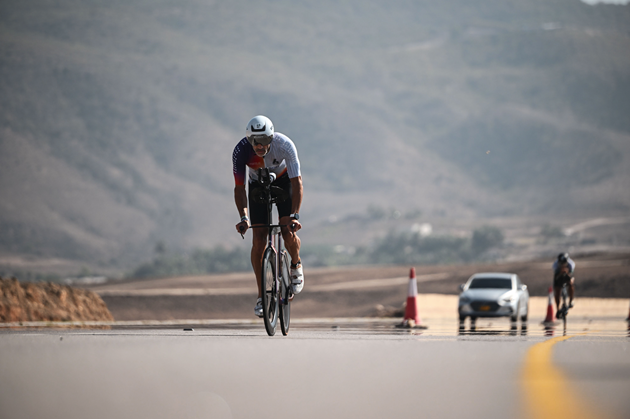
The priority was no longer racing for position. It was managing the cramps and keeping moving.
I took a couple of sodium tablets I’d originally saved for the hot run, hoping they might help. As expected, there was no immediate improvement. I remember telling myself, “Be patient, it might take 20-30 minutes for the cramps to ease.” For almost 30 km, I spun gently uphill and coasted downhill whenever I could.
It was tough watching people overtake me without being able to push the pedals, probably my competition spirit kicking in.
With around 10 km to go, things finally eased a little. For the first time ever, I was actually looking forward to getting off the bike and starting the run.
Bike split: 2:28:34.
The run: one aid station at a time
I arrived in T2 with plenty of doubts. If I was already cramping on the bike, what would a half-marathon look like on limited run training? Probably a long one.
The course was three 7 km loops around the resort, winding through the residences, along the beach, out onto a pier and back through the gardens. Despite the fatigue, I genuinely enjoyed the setting.
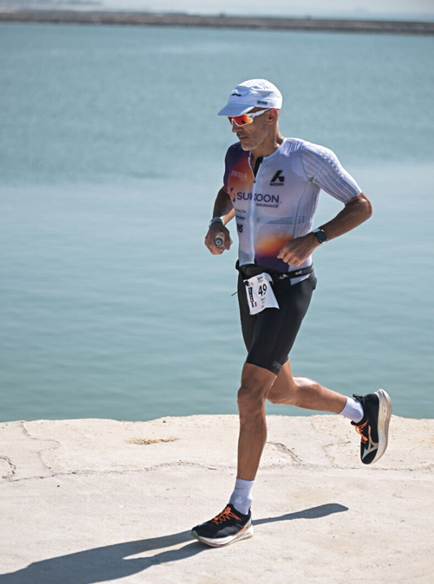
As planned, I started gently, keeping the effort controlled and trying to be kind to my legs. The first 10 km were reasonably manageable, although I had to stop a few times to stretch when the cramps returned.
Somewhere around 10-12 km, Marc caught and passed me on our second lap. I would have loved to stay with him and chase an age-group podium together, he went on to finish second in our age group but that simply wasn’t an option for me that day.
From then on, I stopped at every aid station for water and ice. The heat was taking its toll, and whatever their pace, plenty of athletes around me were having a tough time too.
On the final lap, I remember coming to a complete standstill on the pier, crippled by cramps but still “enjoying” the view. Eventually, with the family and kids cheering me home, I reached the finish line.
Half-marathon: 2:21:47.
Overall: 5:26:07.
More than the finish time
Not the result I’d hoped for on the start line. The run was another tough one, and the bike hadn’t gone to plan either.
But there were positives: an unexpected swim PB, a way through each setback, and the chance to share the whole experience with teammates and family.
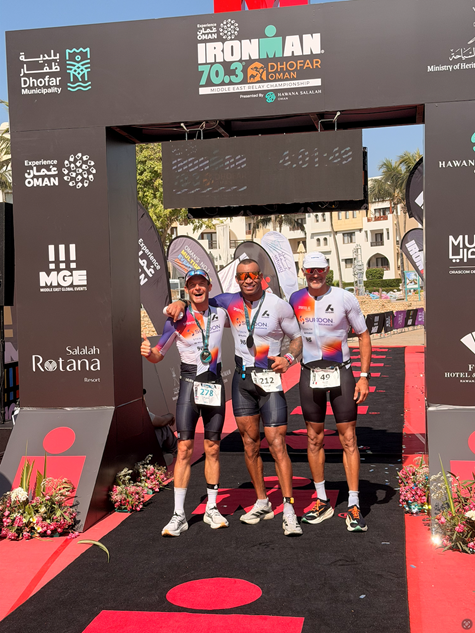
A great event and a beautiful setting. Not quite the race I’d imagined, but still a trip worth making.