

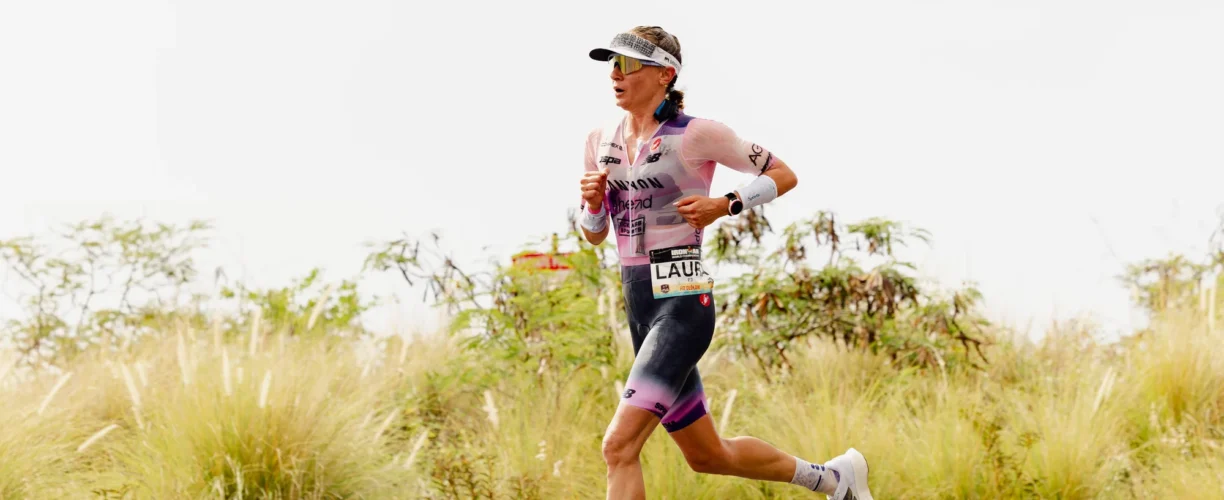
How Laura Philipp Ran the Fastest Women’s Marathon at IRONMAN Kona
The Work Behind the Work · Kona 2026
A few days before the IRONMAN World Championship, we sat down with Laura Philipp in Kona. She told us how she uses LEVER, how she got back on her feet after a rough start to the year, and her top three tips for racing on the Big Island.
Then she went out and ran the fastest marathon in the women's race, moving from 10th off the bike to 2nd at the finish.
2nd IRONMAN World Championship 8:39:34
2:50:43 Fastest women's run 4:03/km · 6:31/mile
+28 Places gained 30th out of the swim to 2nd
+8 Places gained on the run alone

1 - From 30th to 2nd: How Her Race Unfolded
Laura's day didn't start the way she wanted. She came out of a rough, choppy swim in 30th, more than eight minutes behind the leaders. A strong ride brought her up to 10th, but she still started the marathon almost 10 minutes behind leader Taylor Knibb.
30th Swim exit · 1:00:03 8:34 behind the leader after a choppy swim.
10th Into T2 · bike 4:42:59 9:52 behind the leader, with a marathon to go.
4th Halfway through the run Already up six places, still 8:49 down.
3rd 5 miles to go About 5.5 minutes behind the leader.
2nd Finish · 8:39:34 Run 2:50:43, the fastest of the women's race, just over 3 minutes behind Knibb.
Some of those places came as other athletes faded or dropped out in the heat. But that's how Kona works. The marathon exposes everyone, and Laura was running well enough to be there when it mattered. She cut the gap to the leader from nearly 10 minutes to about 3.

2 - The Fastest Run of the Day
Laura's 2:50:43 was the fastest run split in the women's field by more than two minutes. She ran over 7 minutes faster than the winner over the marathon.

2:50:43 Laura Philipp 2nd · fastest run
2:52:49 Kat Matthews 4th
2:57:45 Taylor Knibb 1st
2:58:53 Julie Derron 3rd
Laura's Kona marathon
Pace per km, every 5 km. Bars start at zero, so similar lengths mean similar pace. Shorter bar = faster.
0-5.1 km at 19:38 3:51
5.1-10.5 at 41:11 3:59
10.5-15 at 59:33 4:05
15-19.8 at 1:19:06 4:04
19.8-25.1 at 1:40:08 3:58
25.1-30.5 at 2:02:12 4:05
30.5-35.3 at 2:22:23 4:12
35.3-40.3 at 2:42:56 4:07
40.3-42.2 at 2:50:43 4:06
3:51 Fastest stretch first 5 km
4:12 Slowest stretch 30-35 km
4:03 Average 2:50:43 total
Splits from the IRONMAN tracker, using the closest checkpoint to every 5 km. Pace is for each stretch.
Look at how similar the bars are. After a fast opening 5 km, every stretch stayed between 3:58 and 4:12 per km, through the heat of the Energy Lab and all the way to the finish. Even at 25 km she was still running under 4:00 per km. She didn't speed up at the end. She just slowed down far less than the women ahead of her.
That's the real lesson for any marathon: the runner who slows the least usually wins the second half.
So how do you run that fast after 180 km on the bike? In her own words before the race, it starts with patience:
"...the conditions are so brutal that you really need to listen to your inner voice and believe that your body is telling you what it needs. And if it's to hold back a little bit, that's probably what you should do to see the finish line here." LAURA PHILIPP, BEFORE THE RACE
Starting the run almost 10 minutes back, it would have been easy to panic and chase. Instead, she ran her own race, and the places came to her as others slowed.
3 - Inside Laura's LEVER Training
LEVER is a weekly part of Laura's training, not something she only pulls out when she's hurt.

"I've been using the LEVER system regularly this year, just as last year as well. It's... something I implement into my training structure on a weekly basis." LAURA PHILIPP
Laura's LEVER playbook
Three ways the fastest runner in the women's race uses LEVER:
1 - Leg speed Faster sessions. With a little body weight off, she can run quicker and train her legs to turn over faster, with less impact on every stride."...for faster sessions to get a little bit of more leg speed."
2 - Load management - Taking load off her legs. When her legs need a break, she keeps the run in her week with some body weight off instead of skipping it."...just taking load off my legs whenever needed..."
3 - Building back. Coming back after illness. After stomach problems early in the year cost her a lot of weight and left her feeling weak, LEVER runs helped her ease back into training."...it was just nice to have at least one run using the LEVER system to slowly build back."
Most people think of LEVER as an injury tool. Laura uses it to get faster too, and she ran the fastest marathon in the women's race.
4 - How to Use LEVER Like Laura
Here is a simple starting point for each of her three uses:
1 - Leg speed session. Best for: faster running
Support - Take off 10-15% of your body weight
Session - 6-10 x 30-60 seconds faster than race pace, easy jog between
When - Once a week
Focus - Quick, light steps
2 - Load-off easy run. Best for: tired legs
Support - Take off 15-20% of your body weight
Session - Easy, conversational run
When - The day after a hard session or long run
Focus - Keep the run in your week without the full pounding
3 - Building back. Best for: after illness or time off
Support - Start with more support and reduce it week by week
Session - Shorter, easy runs
When - Only once you're well and cleared
Focus - Ease in instead of jumping straight back to full training
Know when not to run. Laura's own advice: "I think every time when you feel weaker or maybe something hurts, in this case I would recommend to not run at all." Rest first, then build back.
Train like Laura. Less load on easy days. More leg speed on fast days.
LEVER turns your treadmill into a body-weight support system, the same tool Laura uses every week. Shop LEVER
5 - Her Favorite Run Sessions
Laura's favorite sessions might surprise you. She loves fartleks, and she actually enjoys the treadmill.
"I really enjoy just doing, like, fartlek run sessions. They can be longer. And for many people, surprisingly, I really enjoy to run on the treadmill. So often on the weekend, I have a longer tempo run on the treadmill, and this is actually something I enjoy." LAURA PHILIPP
1 - Long fartlek. Laura's favorite
Session - A longer run with surges mixed in
Effort - Change pace by feel, not just by the watch
Recovery - Keep running easy between surges
Why - Teaches you to change gears and settle back in, just like racing
2 - Weekend treadmill tempo. Often on her weekends
Session - A longer tempo run on the treadmill
Effort - Steady and controlled
When - The weekend, when there's time for a longer session
Why - Easy to lock in your pace, with no hills, traffic or weather
6 - Laura's Kona Tips
Before the race, we asked Laura what she was looking forward to most. Her answer is a good reminder for anyone with a big race coming up:
"...I'm looking much forward to race morning. It's always, I think, the most special feeling when you prepare everything, like the final preparation for a big day ahead... And... every year you get a new chance..." LAURA PHILIPP
We also asked for her advice to everyone racing. Beyond running her own race, two more stood out:
"...even put more focus on hydration and fueling... I think don't underestimate your needs, especially after the swim and on the bike." LAURA PHILIPP
"...when it gets extra tough, remind yourself that you choose to do this and that it should also be fun. And thank everyone who is cheering for us out on course and make sure to at least smile a few times." LAURA PHILIPP
7 - What Every Runner Can Learn From Laura
Be patient. Races are often won in the second half. Run your own pace early, and you'll have something left when others slow down.
Fuel early. Your run depends on what you eat and drink before it. Don't wait until you're thirsty or empty.
Train smart, not just hard. Laura runs fast on LEVER and takes load off when she needs it. Consistency comes from both.
More miles. Faster recovery. Fewer setbacks.