

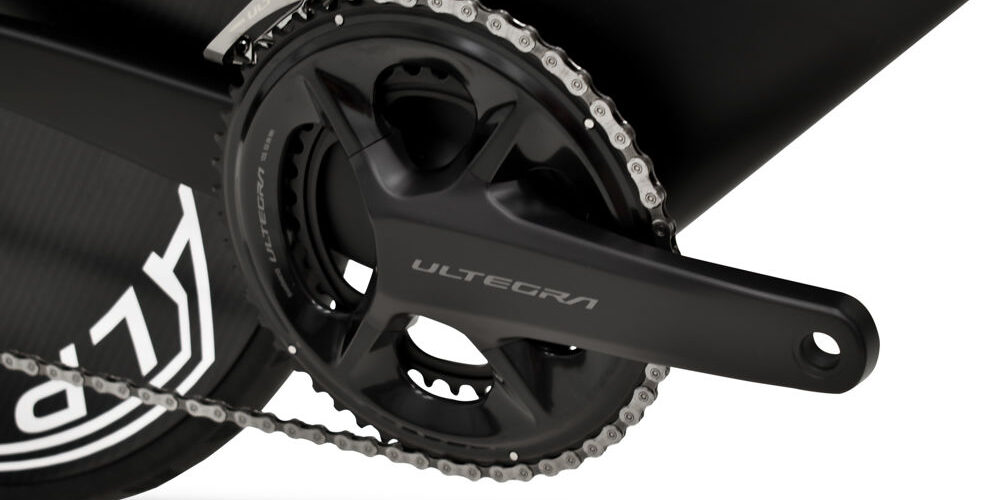
Why More Triathletes in the UAE Are Switching to 165mm Cranks — And Whether You Should Too
If you’ve ever found yourself shifting in discomfort while trying to hold your aero position, or struggling to run smoothly after a strong bike leg, there’s a chance the issue isn’t your fitness — it’s your crank length.
For years, most triathletes have ridden the cranks that came standard with their bike: typically 170mm or 172.5mm. Few ever questioned whether those lengths actually suit their body mechanics. But across the triathlon world — from elite pros to experienced age-groupers — a quiet revolution is taking place.
Athletes are downsizing.
And the reason is simple: shorter cranks, often 165mm or even 160mm, can transform how your body moves through each phase of the triathlon.
The Case for Shorter Cranks
The concept might seem subtle — we’re talking just 5 to 10 millimetres of difference. But in a sport that prizes marginal gains and biomechanical efficiency, those millimetres matter.
When you reduce crank length, you subtly change the geometry of your pedal stroke and your hip angle. It’s a mechanical adjustment that can influence your power output, your comfort in aero, and even how your legs feel when you hit the run.
For triathletes, where the goal is sustained power and efficient energy transfer rather than explosive torque, shorter cranks often provide a better balance between comfort, aerodynamics, and performance.
Opening the Hip Angle: The Aero Advantage
One of the most immediate benefits of shorter cranks is the way they open your hip angle — the space between your torso and thigh at the top of the pedal stroke.
With longer cranks, your knees come higher towards your chest, especially in an aggressive time trial or triathlon position. This compresses your hip angle and can cause a host of downstream problems: restricted breathing, lower back discomfort, and difficulty maintaining aero posture for extended periods.
By shortening the crank, your knees don’t rise as high, allowing you to stay lower on the front end of the bike without closing your hip angle. That means you can hold a more aerodynamic position comfortably — not just for 10km, but for the full 90km or 180km of a long-course race.
It’s the kind of free efficiency triathletes spend thousands chasing through helmets and wheelsets, available from a simple component change.
Comfort Equals Consistency
Triathlon performance is built on repetition. You can only train and race consistently if your position feels sustainable.
Many age-group triathletes juggle work, family, and training — meaning recovery is often limited. If your position on the bike causes chronic tightness through your hips or lower back, those small irritations can build into overuse injuries.
Shorter cranks often ease this strain. By reducing the range of motion through the hips and knees, they promote smoother, more natural pedalling mechanics. The result is not just comfort — it’s longevity.
Athletes who make the switch frequently report that they recover more easily after long rides, and experience fewer flare-ups of hip flexor or IT band tightness.
In short: shorter cranks help you train more, hurt less, and carry fresher legs into your run.
What About Power Loss?
It’s natural to worry that reducing crank length will reduce leverage — and therefore power. After all, a longer lever should, in theory, provide more torque.
But the real-world data paints a different picture.
Several studies, including research published in the Journal of Sports Sciences, have shown that changes in crank length (within a reasonable range) have minimal impact on power output. What matters far more is your overall fit and ability to maintain consistent effort across time.
For triathletes, where efficiency trumps peak torque, shorter cranks can actually improve sustained power because you’re pedalling in a biomechanically neutral position. You can spin a slightly higher cadence, recruit muscles more evenly, and delay fatigue.
As David Hunt, Certified Trisutto Coach and founder of Sported, explains:
“In endurance racing, power isn’t just about how hard you can push in one moment — it’s about how repeatable that effort is over hours. Shorter cranks make that repeatability easier for most athletes.”
Fit Is Everything
Choosing crank length isn’t just a sizing exercise — it’s a conversation about how your body moves.
While shorter athletes (typically under 175cm) often see the most immediate gains, taller riders can also benefit. For them, the advantage is aerodynamic: shorter cranks let them lower their front end without discomfort, improving their drag profile significantly.
Ultimately, the right crank length is the one that supports your best sustainable position — the one that lets you stay aero, breathe freely, and transition smoothly to the run.
That’s why we recommend athletes in the UAE start with a professional bike fit or an assessment session with Sported. A trained fitter can measure your current hip and knee angles, simulate shorter cranks, and determine whether a switch will unlock performance benefits for your specific physiology.
Transitioning to Shorter Cranks
If you decide to try it, the transition is generally smooth. Most riders adapt within a few sessions as their pedalling pattern naturally adjusts to the higher cadence range.
Here’s how to approach it:
- Fit First: Don’t swap cranks blindly. A bike fit ensures your saddle height and reach are adjusted to accommodate the change.
- Listen to Your Body: Expect your cadence to increase slightly — this is normal. Within a week or two, it’ll feel natural, often accompanied by improved comfort in aero.
And because Velo Presto is mobile, they’ll come to your home or training spot anywhere in Dubai or Abu Dhabi, meaning you can explore the benefits without losing training time.
Why It Matters for Age-Group Triathletes
For many UAE triathletes, performance gains are often sought through big investments — lighter wheels, aerodynamic helmets, ceramic bearings. But the most impactful upgrades are often fit-related, not equipment-based.
Crank length is a prime example of this. It’s a relatively inexpensive change that directly affects how efficiently your body moves through all three disciplines.
In a community where training hours are precious and recovery windows are narrow, finding small mechanical advantages that preserve comfort and improve posture can make the difference between a season of consistent progression and one interrupted by injury.
“After decades of coaching and testing equipment, I’ve come to see shorter cranks as one of the most underrated upgrades in triathlon. The benefits show up not just in the data, but in how athletes feel — smoother, fresher, and more confident in aero.
If you’re chasing marginal gains that actually translate to race-day performance, crank length deserves a serious look.”
— David Hunt, Founder of Sported & Certified Trisutto Coach
Ready to Test 165mm for Yourself?
Visit Sported.ae or stop by the Sported shop for a chat and coffee. Our experienced team can help you understand whether shorter cranks are right for your physiology and racing goals, and our partners at Velo Presto can come to you to handle the swap and fine-tuning.