

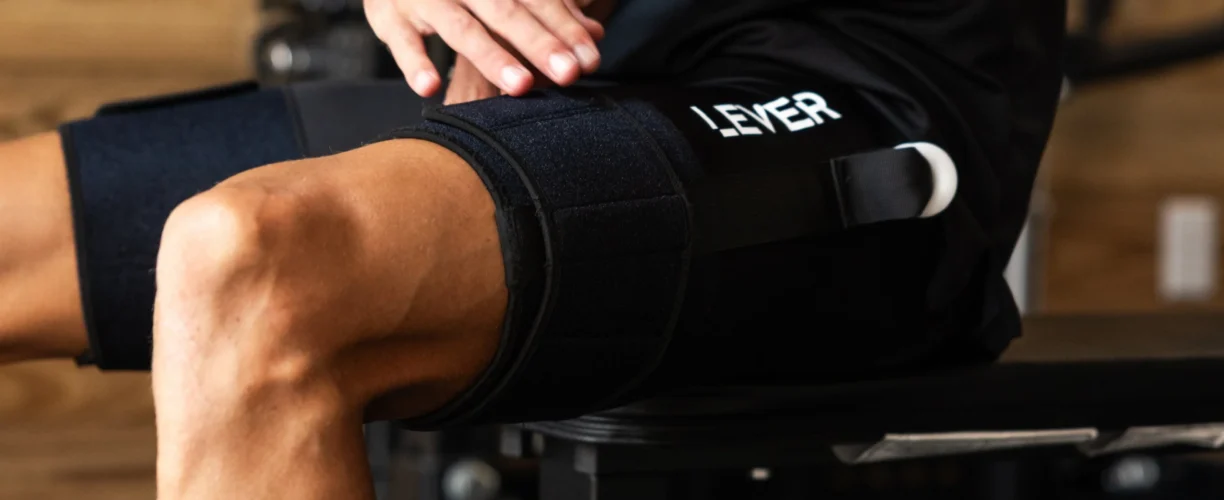
RUNNING THROUGH KNEE PAIN: WHAT ATHLETES NEED TO KNOW
For runners, knee pain is one of the most common reasons training gets derailed. That dull ache around the kneecap during a run, the stiffness after sitting for an hour, the grinding sensation on the stairs. If this sounds familiar, you are likely dealing with patellofemoral pain syndrome, also known as runner's knee. The good news: many athletes don't need to stop running completely. They need to train smarter, build the right strength, and manage load more carefully.
WHAT IS THE PATELLOFEMORAL JOINT?
The patellofemoral joint is formed where the kneecap (patella) sits against the front of the thigh bone (femur). As the knee bends and straightens, the patella glides up and down within a groove in the femur. This sliding mechanism is central to nearly every lower-body movement a runner makes, from the loading phase of each stride to the push-off that propels them forward.
The forces passing through this joint during running are substantial. Patellofemoral joint stress, measured as reaction force per unit of cartilage contact area, increases significantly with knee flexion angle and running pace. Research has shown this stress is meaningfully elevated during running compared to walking, and rises further during downhill running where greater knee flexion is required (Powers, 2010; Brechter and Powers, 2002). Over thousands of loading cycles per session, even small imbalances in how the patella tracks within its groove accumulate into a significant problem.
Patellofemoral pain syndrome (PFPS) is the most common running-related knee injury, accounting for approximately 16% of all running injuries in systematic reviews, and up to 25% of new presentations in sports medicine clinic settings (van der Heijden et al., 2015; Taunton et al., 2002). It affects runners of all levels and both sexes, though research consistently shows higher prevalence in female athletes (Smith et al., 2018).
| High StressPatellofemoral joint stress increases significantly with knee flexion angle and running speed | ~16%Of all running-related injuries across systematic reviews | #1Most common knee injury in recreational runners |
WHAT IS RUNNER'S KNEE?
Runner's knee is the common name for patellofemoral pain syndrome (PFPS), a condition characterized by diffuse pain around or behind the kneecap that is aggravated by activities that load the bent knee. Running, squatting, descending stairs, and prolonged sitting are the classic triggers. Unlike acute knee injuries involving ligaments or menisci, PFPS develops gradually and is driven by cumulative overload rather than a single traumatic event.
The exact mechanism is multifactorial and not fully resolved. Current research suggests that muscle imbalances at the hip and knee may contribute to altered patellar mechanics and uneven pressure distribution across the joint surface. However, not all runners with PFPS show measurable patellar tracking abnormalities on imaging, and the 2016 International Patellofemoral Pain Research Retreat consensus noted that patellar maltracking alone does not reliably explain the condition. Over time, repeated stress from running exceeds the capacity of the cartilage and surrounding soft tissue to adapt (Crossley et al., 2016; Powers, 2010).
There are two main patterns athletes encounter:
PERIPATELLAR PAIN
Around the kneecap
Diffuse aching around the borders of the patella. Most common presentation in runners. Typically aggravated by downhill running and prolonged sitting with knees bent.
RETROPATELLAR PAIN
Behind the kneecap
Pain felt deep behind the patella, often described as a grinding or pressure sensation. More associated with higher-load activities like squatting and stair descent.
EARLY WARNING SIGNS - DON'T IGNORE THESE
- Aching or dull pain around or behind the kneecap during or after running
- Pain when sitting with knees bent for extended periods (the "theatre sign")
- Discomfort descending stairs or walking downhill
- A grinding, clicking, or popping sensation around the kneecap
- Pain that increases with running volume or intensity
- Knee stiffness or swelling after long runs
A key diagnostic feature of runner's knee is the "theatre sign": pain that builds while sitting with knees bent for 20-30 minutes and eases quickly when the legs are straightened. This distinguishes PFPS from other knee conditions such as IT band syndrome, which typically presents as sharp lateral pain at a specific point in the running stride.
HOW RUNNER'S KNEE DEVELOPS
Runner's knee is a classic overuse injury. It develops when the cumulative mechanical stress placed on the patellofemoral joint exceeds the tissue's capacity to tolerate and adapt. It rarely has a single cause. Instead, it typically emerges from a combination of biomechanical, training load, and tissue capacity factors converging over weeks or months.
Of these, hip weakness is one of the most consistently identified contributors in research. Weakness in the hip abductors and external rotators allows the femur to drop inward during the stance phase of running, increasing the dynamic Q angle and compressing the lateral aspect of the patella against the femoral groove. A systematic review by Rathleff and colleagues found that hip muscle weakness is a significant risk factor for patellofemoral pain, particularly in female runners (Rathleff et al., 2014). Combined with a sudden spike in training volume, this hip-knee relationship is often the central mechanism behind PFPS onset.
"Runner's knee is rarely just a knee problem. It is often a hip problem expressing itself at the knee. Weakness in the glutes and hip abductors allows the femur to rotate inward, placing the patella under uneven stress with every stride."
CAN YOU KEEP RUNNING WITH RUNNER'S KNEE?
The short answer is: often yes, with modifications. Complete rest is not the standard recommendation for PFPS because the joint and surrounding musculature need progressive loading to adapt and recover. Research supports a graded-exposure approach, gradually reintroducing load while simultaneously building the strength deficits that contributed to the problem in the first place (Collins et al., 2018).
Running through PFPS without modification, however, tends to perpetuate the issue. The goal is not to avoid loading the patellofemoral joint entirely but to control how much load it receives per session and progressively increase its tolerance over time. Small adjustments including running cadence, incline, surface, and volume can make a meaningful difference in how much stress the joint faces per stride.
REDUCE OR PAUSE IF:
- Pain above 4/10 during running
- Significant swelling around the kneecap
- Symptoms worsening week-on-week
- Suspected meniscal or ligament involvement
MODIFIED RUNNING OFTEN OK IF:
- Pain stays at or below 4/10
- Symptoms return to baseline within 24hrs
- No increase in swelling post-run
- Mild-to-moderate presentation only
Clinical guideline: pain that stays at or below 4/10 during activity and returns to baseline within 24 hours is generally an acceptable training signal during PFPS rehabilitation (Crossley et al., 2016).
EVIDENCE-BASED TREATMENT OPTIONS
The evidence base for PFPS treatment is well developed. Conservative management is effective in the majority of cases. Here is what research currently supports:
Hip and Knee Strengthening
A systematic review and meta-analysis by Nascimento and colleagues (2018) found that combined hip and knee strengthening produced significantly greater pain reduction and functional improvement than knee strengthening alone. Targeting the hip abductors, external rotators, and extensors reduces femoral internal rotation during running, decreasing lateral patellar compression. This is the current gold standard approach for PFPS rehabilitation. Treatment should be individualized, as exercise selection and loading need to account for the athlete's current pain levels and knee flexion tolerance.
Quadriceps Strengthening
The quadriceps, particularly the vastus medialis oblique (VMO), play a central role in patellar tracking. Weakness allows the patella to drift laterally within the femoral groove, increasing contact pressure. Targeted quad strengthening, particularly through terminal knee extensions and step-down exercises, is a foundational component of PFPS rehabilitation alongside hip work.
Gait Retraining
Modifying running mechanics can meaningfully reduce patellofemoral joint stress. Research by Lenhart and colleagues (2014) found that increasing step rate by 10% reduced peak patellofemoral joint force by 14%, primarily by reducing knee flexion excursion at foot contact. Reducing a crossover gait pattern and avoiding excessive forward lean are additional targets that clinicians address through gait retraining.
Load Management
Reducing weekly mileage, avoiding excessive downhill running, and eliminating deep squatting during acute flares. Flat, consistent pacing allows patellofemoral stress to remain predictable and manageable. Gradual reintroduction of hills, stairs, and speed work as strength and tolerance improve.
Patellar Taping and Bracing
McConnell taping and patellar bracing can provide short-term pain relief by altering patellar tracking and reducing lateral compression. Research supports their use as an adjunct to exercise rehabilitation rather than a standalone solution. Useful for allowing athletes to complete strengthening sessions with less pain during the early rehab phase.
Footwear and Orthotics
In runners with significant overpronation, motion control footwear or custom foot orthoses can reduce the valgus knee stress that contributes to lateral patellar overload. Moderate evidence supports their use in specific subgroups, particularly those with flat arches and excessive tibial internal rotation during running (Collins et al., 2018).
Progressive Return-to-Run
Systematic walk/run progressions that increase patellofemoral load gradually, always guided by the 24-hour pain response and concurrent strength milestones. Avoid rushing back to pre-injury volume until strength deficits are resolved.
"Combined hip and knee strengthening is more effective than knee strengthening alone for reducing pain and improving function in patellofemoral pain syndrome. The hip is not a secondary consideration. It is a primary treatment target."
Nascimento et al., 2018, Journal of Orthopaedic and Sports Physical Therapy
HOW BODY-WEIGHT SUPPORT RUNNING HELPS RUNNER'S KNEE
Body-weight support (BWS) treadmill systems provide a clinically valuable tool for runners managing patellofemoral pain. The mechanism is biomechanically direct: by reducing effective body weight during running, these systems proportionally reduce both the ground reaction force and the patellofemoral joint contact stress generated with each stride.
Research has demonstrated that patellofemoral joint stress scales with the magnitude of ground reaction force and the degree of knee flexion during running (Powers, 2010). A 10-15% reduction in effective body weight during treadmill running produces a corresponding reduction in peak patellofemoral loading, sufficient in many cases to allow symptom-free running while the underlying strength deficits are being addressed through rehabilitation.
A particularly valuable application for PFPS is that body-weight support allows athletes to practice higher cadence running and better running mechanics at a reduced load, reinforcing correct movement patterns without the pain response that often drives compensatory gait changes. Athletes can build confidence in their movement before returning to full weight-bearing.
🏃
Mechanics preserved
Natural cadence and running gait maintained without pain-driven compensations that worsen long-term mechanics
❤️
Fitness maintained
Aerobic fitness preserved when full-weight running exceeds the patellofemoral joint's current load tolerance
⚡
Joint still loaded
Meaningful mechanical stimulus for cartilage and soft tissue adaptation without provoking the pain cycle
📈
Controlled progression
Graduated return pathway as strength improves and joint tolerance increases week-on-week
The principle aligns with the graded-exposure model recommended by current PFPS clinical practice guidelines: systematically increasing joint load over time while concurrently building the muscular capacity to support better patellar mechanics (Crossley et al., 2016; Collins et al., 2018). Body-weight support systems make this principle directly applicable to running itself.
HOW ATHLETES USE LEVER TO STAY RUNNING DURING RUNNER'S KNEE REHAB
LEVER is a body-weight support system designed for treadmill running that allows athletes to precisely control the amount of weight reduction during training. For runners managing patellofemoral pain, it can create a thoughtful middle path: continue running, but at a load the patellofemoral joint can currently tolerate.
In practice, an athlete with runner's knee might begin at 10-20% body-weight support, running as if they weigh 10-20% less than their actual body weight. For a 75 kg runner, this reduces effective loading to the equivalent of a 60-68 kg person. That reduction is often enough to bring patellofemoral stress within a symptom-manageable range, allowing running training to continue without aggravating the joint.
Running mechanics - Natural cadence, stride pattern, and running gait maintained. Athletes can practice correct mechanics without the pain response that drives compensatory movement.
Aerobic fitness - Cardiovascular demand largely preserved at reduced support levels, avoiding the significant deconditioning that comes with complete rest.
Patellofemoral loading - The joint still receives meaningful mechanical stimulus to support adaptation, just at a controlled intensity that doesn't perpetuate the pain cycle.
Progressive overload - As hip and quad strength improves and joint tolerance builds, support is reduced in small increments: 15%, 10%, 5%, full weight, creating a structured, measurable return-to-run progression.
Confidence and consistency - Athletes who maintain running through rehabilitation retain the neuromuscular patterns and psychological momentum that support better long-term outcomes.
Athletes who continue modified activity throughout patellofemoral rehabilitation tend to return to sport faster and with better long-term outcomes than those who rest completely (Collins et al., 2018). LEVER makes that modified activity feel like running, because it is.
EXAMPLE RETURN-TO-RUN PROGRESSION
The following is a sample framework for a runner with mild-to-moderate patellofemoral pain syndrome. Individual progressions should always be guided by a sports medicine clinician or physiotherapist. The primary feedback mechanisms are the 24-hour pain response and weekly symptom trend: pain that stays below 4/10 and does not worsen week-on-week indicates the load is being well tolerated.
| PHASE | BWS LEVEL | SESSION STRUCTURE | KEY MILESTONES |
|---|---|---|---|
| Week 1 | 15-20% | Walk/run intervals: 1 min run / 2 min walk x 8-10. Flat surface only, easy pace. 20-25 min total. Hip and quad strengthening performed daily off treadmill. | Pain below 4/10 during. No increase in swelling. Symptoms back to baseline by next morning. |
| Week 2 | 15% | Continuous easy running: 20-30 min. Flat, consistent pace. Focus on increased cadence (aim for 170-175 spm). Continue hip abductor and quad program. | Consistent near-pain-free sessions. Theatre sign reducing. Tolerating 20+ min continuous running. |
| Week 3 | 5-10% | 30-40 min easy runs. Add 4-6 x 20-second strides at end of 2 sessions. Very slight incline (1%) only if pain-free on flat. Continue strengthening with progressive load. | Comfortable with strides. No post-run swelling. Stair descent pain-free or minimal. Hip strength measurably improving. |
| Week 4 | 0-5% to Full | Transition sessions: begin with 5% support, finish final 10-15 min at full weight. Progress toward full weight-bearing 30-40 min runs. Gentle tempo efforts at end of week if symptom-free. | Full weight-bearing running without significant symptoms. Stair descent and squatting pain-free. Ready to resume structured training with ongoing strength maintenance. |
Important: This progression assumes concurrent hip, glute, and quadriceps strengthening throughout all phases. Strength work is not separate from the running progression. It is the foundation it builds on. Always work with a qualified sports medicine professional or physiotherapist to individualize your program.
KEY TAKEAWAYS FOR RUNNERS MANAGING KNEE PAIN
📊
Most common running knee injury
Runner's knee accounts for approximately 16% of all running injuries and responds well to conservative management in the majority of cases.
🚫
Don't rest completely
The patellofemoral joint needs progressive loading to adapt. Total rest removes the stimulus needed for recovery and prolongs the return to running.
💪
Train the hip, fix the knee
Combined hip and knee strengthening outperforms knee-only work. The glutes and hip abductors are primary treatment targets, not secondary ones.
🦵
Running mechanics matter
Increasing step rate, reducing crossover gait, and addressing hip drop can meaningfully reduce patellofemoral stress per stride without reducing running volume.
🎯
BWS extends your options
Body-weight support running allows athletes to continue training at a load the patellofemoral joint can currently handle, preserving fitness and mechanics throughout recovery.
✅
Keep moving
Many athletes don't need to stop running completely. Modified running with proper load management is often both safe and central to recovery.
Runner's knee is not a sign that running has broken your body. It is a signal that your training load has outpaced your current tissue capacity, and that the hip and knee strength supporting your mechanics needs attention.
Build the strength, manage the load, and use every tool available to stay in motion. Most runners come back from patellofemoral pain stronger, more durable, and with better mechanics than before.
References
Brechter JH and Powers CM (2002). Patellofemoral stress during walking in persons with and without patellofemoral pain. Med Sci Sports Exerc. doi:10.1097/00005768-200210000-00009
Collins NJ, et al. (2018). Patellofemoral pain: current theories and interventions. Br J Sports Med.doi:10.1136/bjsports-2017-098717
Crossley KM, et al. (2016). 2016 Patellofemoral pain consensus statement from the 4th International Patellofemoral Pain Research Retreat. Br J Sports Med. doi:10.1136/bjsports-2016-096384
Dempster J, et al. (2021). The prevalence of lower extremity injuries in running and associated risk factors: A systematic review. Phys Act Health. doi:10.5334/paah.109
Lenhart RL, et al. (2014). Increasing running step rate reduces patellofemoral joint forces. Med Sci Sports Exerc.doi:10.1249/MSS.0000000000000084
Nascimento LR, et al. (2018). Hip and knee strengthening is more effective than knee strengthening alone for reducing pain and improving activity in individuals with patellofemoral pain. J Orthop Sports Phys Ther.doi:10.2519/jospt.2018.7365
Powers CM (2010). The influence of abnormal hip mechanics on knee injury: a biomechanical perspective. J Orthop Sports Phys Ther. doi:10.2519/jospt.2010.3337
Rathleff MS, et al. (2014). Is hip strength a risk factor for patellofemoral pain? A systematic review and meta-analysis. Br J Sports Med. doi:10.1136/bjsports-2013-093305
Smith BE, et al. (2018). Incidence and prevalence of patellofemoral pain: A systematic review and meta-analysis. PLoS ONE. doi:10.1371/journal.pone.0190892
Taunton JE, et al. (2002). A retrospective case-control analysis of 2002 running injuries. Br J Sports Med.doi:10.1136/bjsm.36.2.95
van der Heijden RA, et al. (2015). Exercise for treating patellofemoral pain syndrome. Cochrane Database Syst Rev.doi:10.1002/14651858.CD010387.pub2